
If you’ve ever looked in the mirror and wished your teeth were a few shades brighter, you’re not alone. The big question on everyone’s mind is “Just how many shades can teeth whitening actually improve my smile?”
The truth is, most professional whitening treatments can make your teeth anywhere from 2 to 8 shades lighter, depending on your starting color, the type of stains, and the method used. That’s often enough to make your smile look noticeably fresher and more confident without trying to achieve an unrealistic Hollywood white.
In this guide, we’ll walk you through how whitening works, what happens during a procedure, who’s a good candidate, and the factors that affect results. By the end, you’ll know exactly what to expect, how to get the best results, and why even a few shades of improvement can completely change how you feel about your smile.
Am I a Good Candidate for Teeth Whitening?
Whitening is incredibly effective, but it isn’t a magic wand for every type of discoloration. Identifying if you are an ideal candidate can save you time and money.
Ideal Candidates
You will likely see dramatic results if you have extrinsic stains. These are surface-level discolorations caused by:
- Dark-colored beverages (coffee, tea, soda).
- Tobacco use.
- General aging (surface staining over time).
Who Should Be Cautious?
Restorations: If you have tooth-colored fillings, crowns, or bonding on your front teeth, these materials will not change color. Your natural teeth may appear darker than your dental work.
Intrinsic Stains: If your teeth have a greyish or bluish tint because of medication, such as Tetracycline, or nerve damage, then whitening may not have a significant impact.
Sensitivity: If you have gum problems, then you may experience considerable discomfort, especially if you have exposed roots, where there is no enamel.
According to a study published in the Journal of Dentistry, patients with intrinsic stains may undergo procedures such as internal whitening or the placement of veneers.
What Happens During a Teeth Whitening Procedure?
A teeth whitening procedure is a controlled process performed in a clinical setting to achieve the best possible result while protecting your mouth’s soft tissues.
The Step-by-Step Process
Initial Assessment: The dentist checks your teeth for existing fillings, crowns, or dental veneers that don’t whiten, as well as the presence of any active decay.
Professional Cleaning: The dentist gives your teeth a quick prophy, which is essentially a cleaning, to remove pellicle, a thin protein layer.
Gingival Barrier Application: This is the most important step in the teeth whitening procedure, as the dentist applies a light-cured resin or a rubber dam to the gums in order to protect them from the strong bleaching agent.
Gel Application: The dentist applies a strong hydrogen peroxide or carbamide peroxide solution to the teeth.
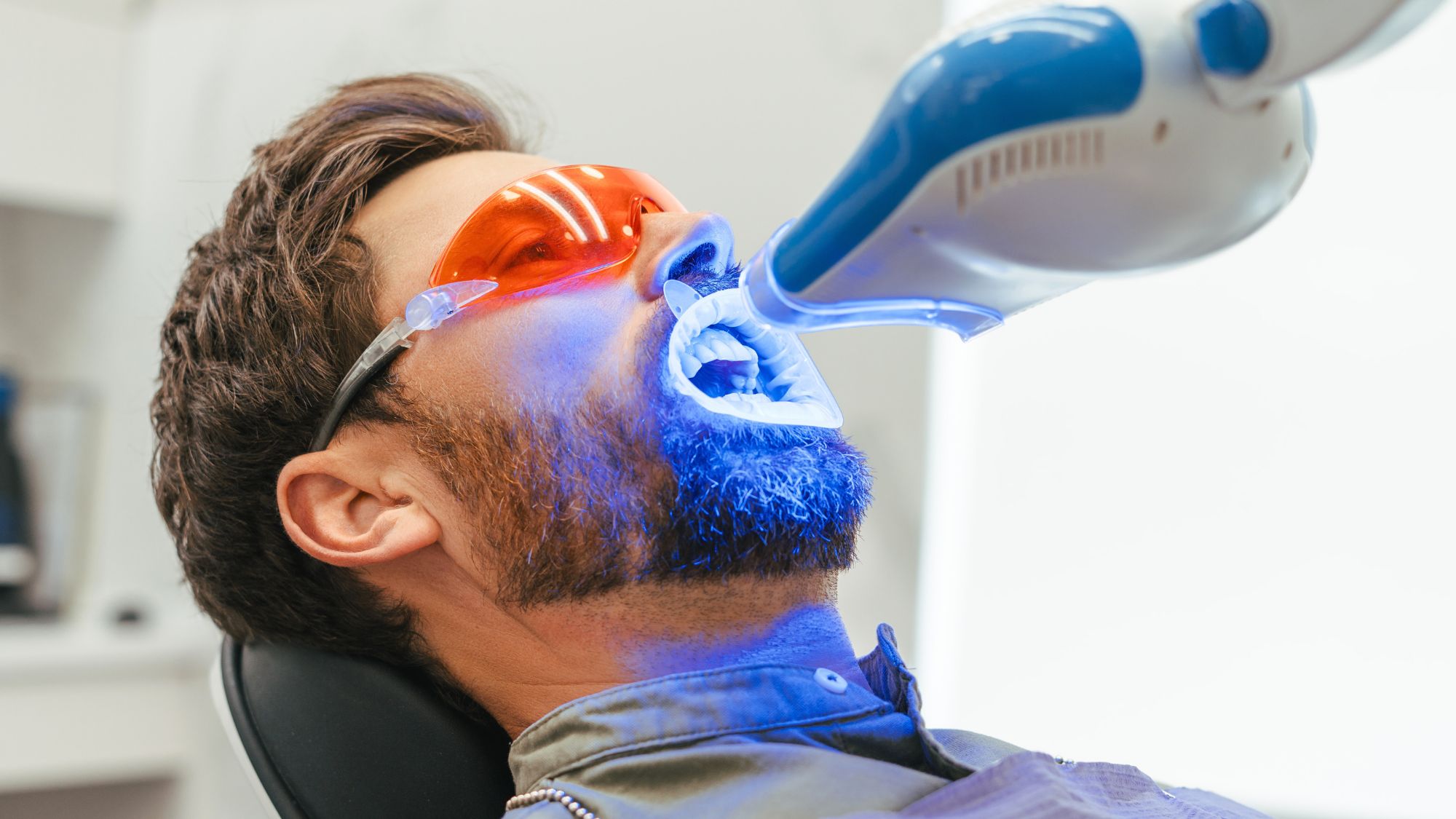
Activation: In most cases, the dentist uses a special LED or laser to activate the molecules in the solution, thereby speeding up the chemical reaction during the teeth-whitening procedure.
Activation: In many offices, a specialized LED or laser light is used to excite the molecules in the gel, speeding up the chemical reaction that breaks down stains.
Rinse and Desensitize: After 15-20-minute intervals (usually repeated 3 times), the gel is washed away, and a fluoride or desensitizing treatment is applied to soothe the teeth.
How Teeth Whitening Works
It’s a common misconception that whitening scrapes away a layer of your teeth. In reality, it is a chemical process of oxygenation.
Professional vs. Over-the-Counter
The primary difference is concentration. OTC products generally contain 3% to 10% hydrogen peroxide. Professional-grade gels can range from 25% to 40%. Because a professional can protect your gums, they can use a much stronger formula that penetrates deeper into the enamel more quickly.
The Mechanism
Bleaching agents contain oxygen molecules that travel into the microscopic pores of your enamel. These molecules find the long-chain chromogen (stain) molecules and break their chemical bonds. When these large stain molecules are broken into smaller, colorless fragments, the tooth reflects more light and appears brighter.
Expected Shade Improvement
While many advertisements claim 10 shades in an hour, a realistic expectation for most patients is a 4- to 6-shade improvement. Moving 8 shades is possible for those with heavy staining, but those with relatively light teeth may only move 2 or 3 shades to reach their maximum natural brightness.
How to Know Your Shade Improvement
The only way to accurately track your progress is through professional documentation.
Shade Matching Before and After
Your dentist will use the VITA guide at the start and end of the appointment. Often, they will take high-resolution photos in the same lighting to show you the side-by-side difference. This helps manage realistic expectations. It is important to remember that tissue-paper white is rarely a natural look; the goal is usually a shade that complements your skin tone and matches the whites of your eyes.
When Whitening Isn’t Enough
If you reach your plateau and still aren’t happy with the color, you might discuss porcelain veneers or dental bonding. These options allow you to choose a permanent shade that fully covers the natural tooth.
Tips to Maximize Your Results
Once you have invested in a brighter smile, you’ll want to keep it that way. The first 48 hours after treatment are critical because the “pores” of your teeth are still slightly open.
The White Diet: For two days, avoid “staining” foods like balsamic vinegar, soy sauce, berries, and dark coffee. Stick to white foods like chicken, pasta, cauliflower, and water.
Oral Hygiene: Brushing twice a day and flossing prevent the buildup of new surface stains.
Maintenance Kits: Many people find success using custom-made take-home trays provided by their dentist for a touch-up once every few months.
Teeth Whitening in Livingston: If you are in the local area, seeking a consultation for teeth whitening in Livingston can provide you with a personalized shade assessment to see exactly what is achievable for your specific dental profile.
Conclusion
Teeth whitening can make a real difference in your smile, often lightening your teeth by 2 to 8 shades, depending on your starting color, the type of stains, and the treatment method. Even small improvements can boost your confidence and make your smile feel brighter and healthier.
Understanding the process and knowing if you’re a good candidate helps you get the results you want safely. If you’re ready to see how bright your smile can become, schedule a visit with The Honest Crown today.