
A dental cleaning without insurance typically costs $75 to $200 for the cleaning alone. A new patient who also needs an exam and X-rays usually pays $150 to $350 in total. If gum disease is present, a deep cleaning can run $200 to $400 per quadrant. Prices in New Jersey tend to sit toward the higher end of these ranges.
Those figures are only a starting point, because the final bill depends on what your mouth needs. This guide explains what you are paying for, why quotes differ so much from one office to the next, and how to lower the cost without cutting corners on your health.
Dental Cleaning Cost Without Insurance at a Glance
| Service | Typical Cost Without Insurance | What It Covers |
| Routine cleaning (prophylaxis) | $75 – $200 | Plaque and tartar removal, polishing |
| Comprehensive new-patient exam | $50 – $150 | Full check of teeth, gums, and soft tissue |
| Bitewing X-rays | $25 – $100 | Decay between teeth, bone levels |
| Full-mouth or panoramic X-rays | $75 – $250 | Complete diagnostic image of your mouth |
| Fluoride treatment | $20 – $50 | Enamel strengthening |
| Deep cleaning (per quadrant) | $200 – $400 | Scaling and root planing below the gumline |
| Periodontal maintenance | $100 – $250 | Ongoing cleaning after gum disease treatment |
These are general U.S. ranges, not a quote. Your actual cost depends on your oral health and the office you choose.
What Is Included in a Standard Dental Cleaning?
A routine cleaning is preventive care. It removes buildup your toothbrush and floss cannot reach, helping keep small problems from becoming expensive ones. A professional teeth cleaning visit usually includes four steps:
- Plaque and tartar removal: The hygienist uses hand instruments or an ultrasonic scaler to clear soft plaque and hardened calculus from your teeth and along the gumline.
- Polishing: A gritty polishing paste removes surface stains and leaves enamel smooth, which makes it harder for plaque to stick.
- Flossing: Your teeth are flossed to clear debris between them and to show where your gums bleed.
- A quick gum and tooth check: The hygienist looks for inflammation, early cavities, and anything unusual to flag for the dentist.
Notice what is missing from that list. The dentist’s exam, X-rays, and fluoride are usually billed separately. When an office advertises a very low cleaning price, check whether the exam and X-rays are included, because that difference is where many “cheap” quotes fall apart.
Why Dental Cleaning Prices Vary So Much
Two offices in the same county can quote very different numbers for what sounds like the same service. These are the factors behind the gap.
The Type of Cleaning You Need
A standard cleaning is designed for healthy gums. If you have not seen a dentist in years and have heavy buildup, the hygienist may need to do a full-mouth debridement first. That clears thick deposits so the dentist can see your teeth properly. If infection has settled below the gumline, you need a deep cleaning instead, which is a more involved and more expensive procedure.
Exams and Diagnostic X-Rays
A dentist cannot safely treat what they cannot see. New patients almost always need a full exam and X-rays before the cleaning begins. Returning patients typically need only an annual set of bitewings. This single factor often accounts for half of the total bill.
The Condition of Your Gums
Bleeding, swollen, or receding gums take longer to treat and call for different tools. The more tartar and inflammation present, the more clinical time your visit requires, and the cost rises.
Office Location and Technology
Rent, staffing, equipment, and local demand all shape fees. Practices in the New York–New Jersey region generally charge more than those in lower-cost areas. Offices that invest in digital imaging and modern sterilization may charge more, but they often catch problems earlier, which saves you money later.
Regular Cleaning vs. Deep Cleaning: What Is the Cost Difference?
This is the most common source of surprise on a dental bill, because the two are different procedures with different goals.
A regular cleaning maintains healthy gums by removing buildup from the visible tooth surface and just under the gumline. A deep cleaning, called scaling and root planing, treats active gum disease. The hygienist cleans below the gumline to remove bacteria and tartar from the root surfaces, then smooths those surfaces so the gums can reattach.
Because it is a treatment rather than maintenance, a deep cleaning is usually done one or two quadrants at a time, often with local numbing. That is why it costs several times more than a standard visit, and why a full mouth can total $800 to $1,600 without insurance.
A deep cleaning is not an upsell when you truly need it. Untreated gum disease is a leading cause of adult tooth loss, and catching it early often means simpler care through periodontal treatment instead of surgery later.
After a deep cleaning, most patients move to periodontal maintenance visits every three to four months. These cost more than a standard cleaning but far less than repeating the full treatment.
What Does a Dental Cleaning Cost in Livingston, NJ?
National averages do not tell you what you will pay down the street. In Livingston, a basic cleaning without insurance commonly runs from about $100 to $225, and a complete new-patient visit with an exam and X-rays often totals $200 to $350 at traditional practices.
At The Honest Crown, we built our pricing for people without insurance. Our new-patient special bundles a cleaning, exam, and X-rays for $99, and a more comprehensive $199 package adds a 3D scan. These offers are for new patients without insurance and without active gum disease, so call to confirm what applies to you.
Our approach is simple: you get a written treatment plan with costs before any work begins, and we recommend only what your mouth actually needs. Patients looking for a transparent dentist in Livingston often tell us that clear pricing was the deciding factor.
How Much Does a Cleaning Cost for Kids?
Children’s cleanings are usually less expensive than adult visits, typically $50 to $150 depending on the exam and whether X-rays are needed. Kids often need fewer X-rays, and their cleanings are shorter because there is less buildup.
Fluoride treatments and sealants are separate line items. Sealants protect the chewing surfaces of back teeth, which matters because CDC oral health data shows cavities are among the most common chronic conditions in childhood. Starting good habits early means fewer fillings later, which is where family dental budgets usually take the biggest hit.
Smart Ways to Pay Less for a Dental Cleaning Without Insurance
Skipping insurance does not mean paying full sticker price. These options can meaningfully lower the cost.
New-Patient Specials
Many practices discount the first visit to earn your trust. Compare the full package, not just the cleaning line. A special that includes the exam and X-rays is worth far more than a low cleaning price with those added on top.
In-House Savings Plans
An in-house plan is often the best value for uninsured patients. Our Honest Savings Plan works like a membership: you pay a low annual fee, and it covers preventive care, including exams, cleanings, and X-rays. You also receive discounts on other procedures if you need them later. No claim forms or insurance paperwork.
Dental Discount Plans
These are not insurance. You pay an annual fee to access reduced rates at participating dentists. They can help if your dentist participates, but always confirm the exact discount on the procedure you need before you join.
Payment Plans and Financing
For larger treatments such as a deep cleaning, monthly payment options can spread the cost over time. Ask about interest rates and terms before you agree, and avoid financing for routine cleanings you can pay for outright.
An Itemized Written Estimate
Always ask for a written estimate that lists the cleaning, exam, X-rays, and any extras. It protects you from surprises and makes it easy to compare offices fairly.
Is It Worth Skipping a Cleaning to Save Money?
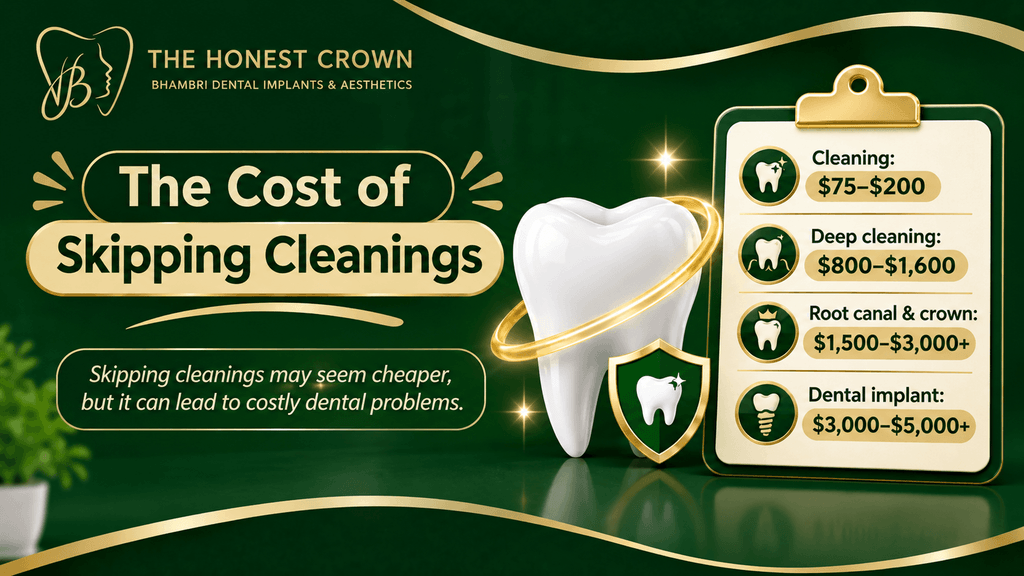
Skipping cleanings feels like savings, but it usually costs more in the long run. Plaque hardens into tartar within a few days, and once that happens, removing tartar at home is not realistic or safe. Only professional instruments can clear it without damaging your enamel or gums.
Left alone, tartar irritates the gums and leads to gingivitis and, eventually, periodontitis. Here is how the costs compare:
- A routine cleaning: roughly $75 to $200
- A deep cleaning for gum disease: $800 to $1,600 for the full mouth
- A root canal and crown: often $1,500 to $3,000 or more
- A dental implant to replace a lost tooth: commonly $3,000 to $5,000 or more
Preventive care is clearly the cheapest path. It is also the most comfortable one, since problems caught early rarely hurt.
How Often Should You Get a Dental Cleaning?
Most children and adults do well with a cleaning every six months, and the American Dental Association supports regular professional visits for the same reason. That schedule lets your dental team catch cavities and gum changes while they are still small and inexpensive to fix.
Some people need visits every three to four months. This includes people with a history of gum disease, diabetes, dry mouth, smoking habits, or a tendency to build up tartar quickly. Your dentist will recommend a schedule based on your own risk, so follow it rather than a generic calendar.
Between visits, the basics matter most: brush twice a day with fluoride toothpaste, clean between your teeth daily, and limit sugary drinks.
Signs You Should Not Wait for Your Next Cleaning
Some symptoms mean you should book sooner rather than later. See a dentist if you notice:
- Gums that bleed when you brush or floss
- Persistent bad breath that does not go away
- Gums pulling away from your teeth
- Tooth sensitivity that keeps getting worse
Red, puffy, or swollen gums are often the earliest sign of gum disease. A single swollen spot near a back tooth can point to a different cause, such as an erupting wisdom tooth or a trapped food particle. Either way, your gums are telling you something, and an exam is how you find out what.
Red Flags When Comparing Dental Cleaning Prices
A low number is not always a good deal. Watch for these warning signs when you compare quotes:
- A price that leaves out the exam and X-rays. You may be quoted $50 and billed $250.
- No written estimate. A trustworthy office puts costs in writing.
- Pressure to buy a deep cleaning right away. A deep cleaning should be based on measurable findings, such as pocket depths and X-ray bone levels, and your dentist should be able to show you the evidence.
- Vague answers about what is included. If the front desk cannot explain the quote, keep looking.
Ask three questions before you book: What exactly does this price include? Do the exam and X-rays cost extra? What happens if you find gum disease?
Frequently Asked Questions
Can I get a dental cleaning without insurance?
Yes. Dentists welcome self-pay patients, and many offer specials or membership plans that make the cost predictable. You do not need insurance to book a cleaning.
Is a cheap cleaning as good as a more expensive one?
Not always, but price alone does not tell you. A lower price can be perfectly good care. What matters is that the visit includes a proper exam and the right X-rays, and that the team is thorough. Compare the full package and the office’s reputation, not just the headline number.
Why do I need X-rays at a cleaning?
X-rays show decay between teeth, bone loss, and infections that cannot be seen during a visual exam. Without them, a dentist is working with half the picture. Most patients need a set every one to two years, based on risk.
Does a cleaning hurt?
For most people, a routine cleaning is comfortable. You may feel pressure or mild sensitivity, especially if your gums are inflamed. If you are anxious or have sensitive teeth, tell your hygienist so they can adjust their approach.
Is a deep cleaning always necessary?
No. It is only recommended when there is evidence of gum disease, such as deep pockets around the teeth or bone loss on X-rays. If you have healthy gums, a standard cleaning is the right treatment.
What if I have tooth pain before my cleaning appointment?
A cleaning will not fix a toothache, so tell the office when you book. In the meantime, there are safe ways to stop tooth pain for a few hours, such as rinsing with warm salt water or taking an over-the-counter pain reliever as directed. Pain usually signals a problem that needs an exam, so do not wait for your regular visit.
What is the cheapest way to get regular cleanings without insurance?
For most people, an in-house savings plan or a new-patient special offers the best value. If you plan to come twice a year, a membership that bundles two cleanings, exams, and X-rays usually costs less than paying per visit.
Final Thoughts
A dental cleaning without insurance does not have to be a financial guessing game. Expect roughly $75 to $200 for the cleaning itself, $150 to $350 once the exam and X-rays are added, and more if gum disease requires a deep cleaning. The best way to keep that number low is to stay consistent with preventive visits and choose an office that is upfront about every line of the bill.
At The Honest Crown, Dr. Vishal Bhambri and our team believe you should know your costs before treatment starts. Call (973) 821-0030 or book online to take advantage of our new-patient specials.