
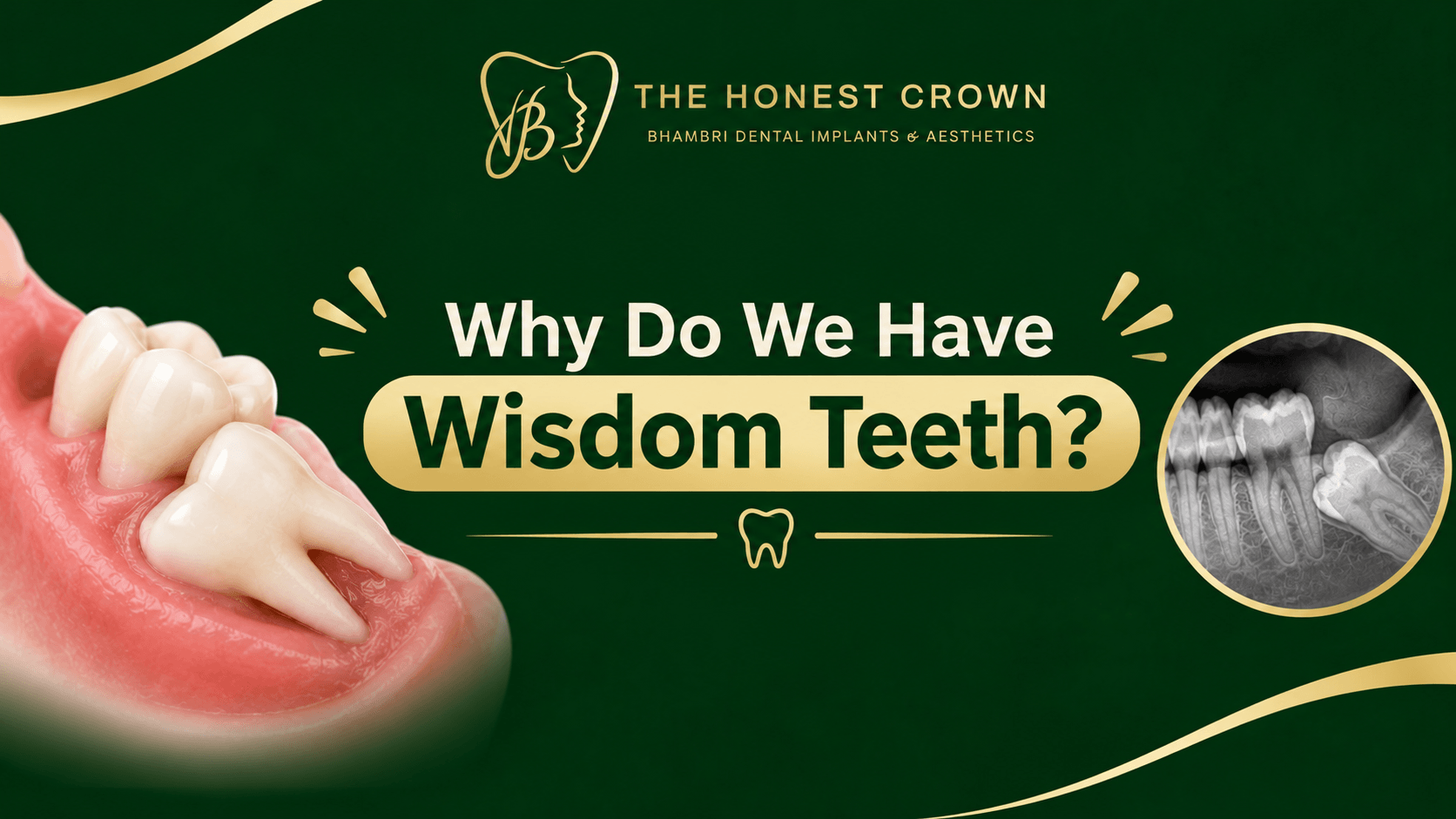
We have wisdom teeth because we inherited them from ancestors who needed extra chewing power. Early humans ate tough, raw foods that wore down teeth quickly, and their larger jaws had room for a third set of molars. Today our food is softer, and our jaws are smaller, so wisdom teeth often have no room to come in properly.
That mismatch between old teeth and modern jaws is why wisdom teeth cause so many problems. This article explains where they came from, why some people never get them, why they so often get stuck, and how to know if yours need attention.
What Are Wisdom Teeth?
Wisdom teeth are your third molars, the last teeth in each corner of your mouth. Most people have four: two on top and two on the bottom, behind the second molars. They start forming in the jaw during childhood and usually push through the gums in the late teens or early twenties.
The name comes from their timing. They arrive in early adulthood, when a person is supposedly older and wiser. The old Latin term, dens sapientiae, means “tooth of wisdom.”
Not everyone gets a full set. Some people have one, two, or three, and some have none at all. Others have wisdom teeth that never break through the gum and stay hidden in the bone for life.
Why Did Humans Evolve Wisdom Teeth?
Scientists explain wisdom teeth with a few connected ideas.
A Tougher Diet
Our early ancestors ate raw plants, roots, nuts, seeds, and tough meat. This kind of food needs a lot of grinding, and it wears teeth down quickly. A wisdom teeth diet required extra chewing power, so a third set of molars, arriving in adulthood, provided fresh grinding surfaces just as the first molars wore down. For them, wisdom teeth were useful equipment.
Bigger Jaws
To chew tough food all day, early humans needed strong jaw muscles and large jaw bones. That gave them plenty of space for 32 teeth.
Cooking, Tools, and Farming
Over time, humans learned to cook food, cut it with tools, and grind it before eating. Later, farming made food softer still. With less chewing work, the jaw had less reason to grow large.
Some research suggests jaw growth in childhood also responds to how hard the jaw works. A child who chews tough food builds a larger jaw than a child raised on soft food. This may help explain why jaws shrank faster than genes alone could account for.
The Mismatch
Genes control tooth size and number, and those genes changed slowly. Jaw size shrank faster. The result is a set of teeth that were designed for a bigger jaw. That mismatch drives most wisdom tooth trouble today.
Why Don’t Some People Have Wisdom Teeth?
Missing wisdom teeth are common. A peer-reviewed study published in the National Library of Medicine’s database found that about 22.6% of people are missing at least one permanent tooth when third molars are counted. For most, the missing teeth are wisdom teeth. The rate varies widely between populations, from around 5% to 37%.
This condition is called third molar agenesis, meaning the tooth never formed. It tends to run in families because genes that guide tooth development play the biggest role. Smaller jaws are also linked to missing wisdom teeth.
Some people wonder if this means humans are evolving to lose wisdom teeth. Some researchers see it as a long-term trend. But evolution has no goal and no ladder. Having no wisdom teeth doesn’t make you “more evolved,” and having them doesn’t make you less so. It is just normal variation.
Are Wisdom Teeth Useless?
Not always. A wisdom tooth that comes in straight, has room, and is easy to clean can work like any other molar. It helps you chew, and it can cause no trouble for your whole life.
In some cases, healthy wisdom teeth can even be useful later. If a dentist needs to remove a damaged molar, a wisdom tooth can sometimes take its place. But many wisdom teeth do not fit well, and that is where problems start.
Why Wisdom Teeth Cause Problems
The main issue is space. By the time wisdom teeth try to come in, the other 28 teeth are already in place. If there is not enough room, the tooth gets stuck. Dentists call this impaction.
An impacted tooth can:
- Stay under the gum or inside the bone
- Grow at an angle toward the next tooth
- Come in only partway, leaving a flap of gum over it
- Grow sideways
The American Dental Association explains that wisdom teeth may need to be removed when they cause pain, infection, cysts, or damage to nearby teeth. Some impacted teeth cause no symptoms, which is why regular X-rays matter.
Common Problems Caused by Wisdom Teeth
Gum Infection Around the Tooth
A wisdom tooth that is only partly through the gum can trap food and bacteria under a small flap of tissue. This causes pericoronitis, an infection that leads to pain, swelling, bad breath, a bad taste, and trouble opening your mouth. Sometimes it causes a swollen gum limited to one spot at the back of the jaw.
Tooth Decay
Wisdom teeth sit far back, where a toothbrush and floss can barely reach. Decay can start on the wisdom tooth itself and also on the second molar in front of it.
Damage to the Next Tooth
An impacted tooth can press against the second molar. Over time, this can cause decay, root damage, or bone loss around that healthy tooth.
Cysts
In rare cases, a fluid-filled sac can form around an impacted tooth. If it is not treated, it can damage the jawbone and nearby teeth.
What About Crowding?
Many people believe wisdom teeth push the front teeth out of line. Research has not clearly proven this. Crowding alone usually isn’t a reason to remove them, so your dentist will look for other signs.
Wisdom Teeth Myths and Facts
| Myth | Fact |
| Everyone must have their wisdom teeth removed | Healthy, well-positioned teeth can stay |
| If it does not hurt, nothing is wrong | Some problems grow quietly, so X-rays matter |
| People without wisdom teeth are more evolved | It is natural variation, not a ladder |
| Wisdom teeth always cause crowding | Evidence for this is weak |
| Wisdom teeth only appear in old age | Most erupt in the late teens or early twenties |
When Do Wisdom Teeth Need to Come Out?
Your dentist will decide based on an exam and X-rays. Removal is usually advised when a wisdom tooth:
- Is impacted and causing symptoms
- Keeps getting infected
- Has decay or gum disease that cannot be treated
- Is damaging the next tooth
- Has a cyst around it
Sometimes dentists recommend removal early, before the roots are fully formed, because it is usually easier and recovery is faster. If your dentist suggests a tooth extraction, they should explain why it is needed, what will happen, and what it costs.
Signs Your Wisdom Teeth Need Attention
You do not have to wait for severe pain. Watch for these signs:
- A dull ache or pressure at the back of your jaw
- Red, swollen, or tender gums near the back molars
- Bad breath or a bad taste that will not go away
- Trouble opening your mouth fully
- Pain when you bite down on the back teeth
- Headaches or jaw soreness
The first signs of wisdom teeth coming in are often a dull ache and tender gums at the back of the mouth. If you have swelling, fever, or trouble swallowing, get care right away.
What Happens If You Need Removal?
Wisdom teeth removal is one of the most common oral procedures. The area is numbed, and sedation can help if you feel nervous. The Honest Crown offers nitrous oxide, oral sedation, and IV sedation for extractions, and a 3D scan can show exactly where each tooth sits and how close it is to a nerve.
Most people want to know the average removal time before they book. A simple tooth comes out quickly, while impacted teeth take longer. Recovery takes a few days of rest, soft foods, and careful aftercare.
Why Regular Checkups Matter
Even if your wisdom teeth feel fine, regular X-rays can show how they are growing. Your dentist can spot an impacted tooth, early decay, or a cyst long before you feel anything.
New patients without insurance can book a $199 cleaning, exam, and 3D scan if they have no gum disease. It gives you a clear picture of your wisdom teeth and tells you whether they can stay or need a plan.
Quick Answers About Wisdom Teeth
At what age do wisdom teeth come in?
Most people get them between the late teens and early twenties. Some come in later, and some never come in.
Is it normal to have fewer than four wisdom teeth?
Yes. About one in five people is missing at least one wisdom tooth.
Can you live without wisdom teeth?
Yes. Your other 28 teeth handle chewing, so you can eat and speak normally without them.
Do wisdom teeth make you wiser?
No. The name comes from the age they arrive, not from any link to intelligence.
Final Thoughts
Wisdom teeth are a leftover from a time when people chewed tougher food and had larger jaws. For some people, they cause no trouble. For many others, they are crowded, stuck, or hard to clean, and they may need to be removed.
If you are not sure what your wisdom teeth are doing, the team at our Livingston dental clinic can examine them and explain your options. Call (973) 821-0030